
Hold, send, and swap frontier assets (USDG & native ETH) privately with a signing key split into three independent shards (2-of-3 quorum).

Why choose Privatum for private self-custody?
A 2-of-3 smart wallet architecture engineered for Robinhood Chain: frontier asset settlement (USDG & native ETH), automated policy co-signing, and passkey recovery.
Single-Key Hot Wallet
Stores the complete private key in one browser or device, so one compromise can authorize every transaction.
Hardware Wallet
Improves offline key isolation but adds hardware cost, firmware trust, shipping friction, and seed backup burden.
2-of-3 Threshold Quorum
Splits signing authority mathematically across client Shard A (OS Keystore), Shard B (Co-signer policy engine), and Shard C (Hardware passkey). No single party can move funds.
The 5-Step Signing Pipeline
Zero single points of failure. Every transaction requires off-chain ECDSA shard aggregation from two independent parties before executing on Robinhood Chain.
Build
Desktop or SDKPrepares an unsigned ERC-4337 UserOperation for USDG stablecoin or native ETH transfer.
Client Sign
Local OS Keystore (Shard A)Client decrypts Shard A via device credentials (Keychain, DPAPI) and signs the userOpHash.
Co-Sign
Co-Signer API (Shard B)Payload dispatched over TLS. Engine evaluates daily spend limits and velocity rules, then signs with Shard B.
Combine
Aggregation EngineThe two 65-byte signatures merge into an aggregate 130-byte threshold payload without assembling the root key.
Settle
Robinhood ChainDispatched to Robinhood Chain bundler. PrivatumAccount contract validates 2-of-3 quorum and executes.
Robinhood Chain Specifications & Endpoints
4663| Method | Endpoint | Description | Payload / Notes |
|---|---|---|---|
| GET | /health | Service health, version, and Robinhood Chain ID check | { status: "ok", chainId: 4663 } |
| POST | /v1/wallets | Registers a new 2-of-3 threshold smart account | { address, shardAPubkey, shardBEncrypted, shardCPasskeyPubkey } |
| POST | /v1/cosign | Submits UserOp for policy validation and Shard B co-signing | { walletAddress, asset, amount, userOpHash, recipient } |
Private frontier asset payments built for Robinhood Chain
Privatum delivers non-custodial USDG and native ETH settlement with 2-of-3 threshold security, automated policy co-signing, and passkey recovery.
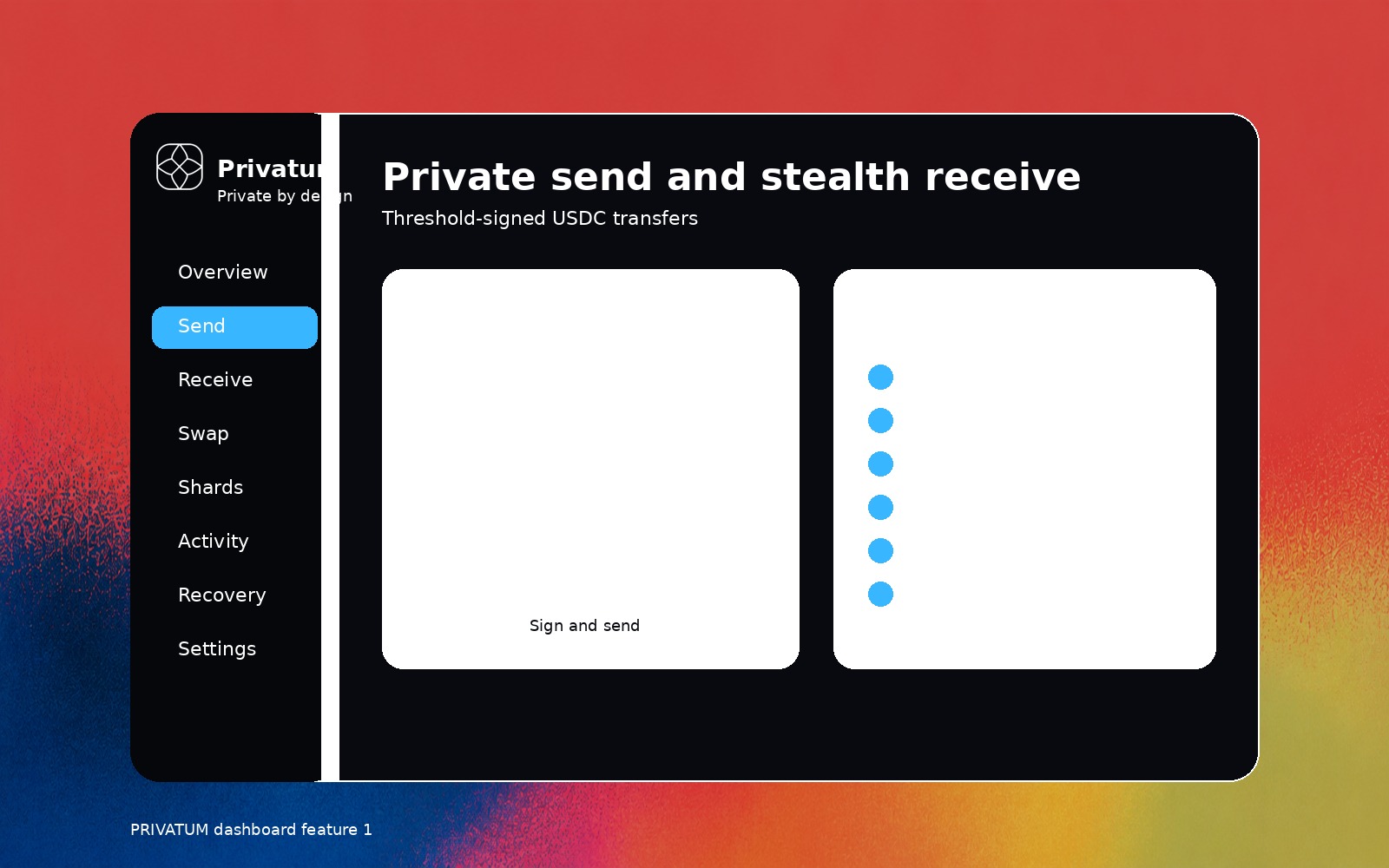
Download Privatum Desktop
Threshold custody, frontier asset settlement (USDG & native ETH), stealth addresses, and atomic swaps natively on your desktop. Built with Tauri v2 and Rust, connected directly to Robinhood Chain.
Windows
64-bit (x64)macOS
Apple Silicon (arm64)Linux
x64 / amd64sudo apt install ./*.deb • Arch/Fedora: run AppImage or native binaryBridge across four chains and earn the spread back
Every bridge pays the relayer a spread on top of destination gas. Privatum returns 25% of that spread to you in PRIV, settled on Robinhood Chain.
Bridge through Privatum
Move ETH or USDG between Ethereum, Base, Arbitrum and Robinhood Chain. Routing and quotes come from Relay.
The spread is measured, not estimated
Every quote separates destination gas from the relayer's margin. Only that margin - the spread - is rebated.
Claim in PRIV on Robinhood Chain
Rebates accrue once a bridge settles and are claimable in PRIV, with the amount fixed at the price on claim.
Figures from a live Relay quote. Rebates accrue per bridge and are claimable in PRIV on Robinhood Chain once the bridge settles.
0xee2ddd7128c291b027712eca157b3ff31a55a05aBuild and launch private payment flows with confidence
Create threshold-secured payment workflows for users, teams, and developers using a native desktop app and open SDK.
Reliable custody that continuously verifies itself
Continuously monitor shard readiness, policy checks, activity, and recovery paths before funds move.
Shard health monitoring
Check client, co-signer, and passkey readiness before a transaction reaches the signing pipeline.
Co-signer policy enforcement
Validate session, transaction intent, spending limits, velocity, and anomaly signals before the second signature.
Activity and recovery visibility
Track settlement history, export activity, rehearse recovery, and rotate a lost client shard without a seed phrase.
Discover the full potential of Privatum Live
See how threshold custody coordinates private send, stealth receive, swaps, policy checks, and recovery in one operational flow.
Research driving the Privatum product thesis
What wallet drainers, custodial collapse, hardware recovery, and privacy infrastructure reveal about modern custody.



Connect every payment touchpoint effortlessly
Private Send

Transfer stablecoins through a two-shard signing flow with policy checks.
Stealth Receive
Share one handle while incoming payments arrive at one-time addresses.
In-Wallet Swaps

Swap supported stablecoins with route, quote, and slippage visibility.
Open SDK
npm →
Embed threshold wallets into applications with a Viem based TypeScript SDK.
Enterprise security for every private payment


Reach users across every payment surface
Privatum connects desktop, Viem SDK, Robinhood Chain, USDG & ETH swaps, stealth receive, and recovery surfaces in one 2-of-3 custody model.
$24,806.42
Roadmap to native privacy.
Robinhood Chain Custody MVP
ERC-4337 smart accounts, 2-of-3 threshold sharding and passkey recovery, live on Robinhood Chain mainnet with a Tauri v2 desktop client.
Open SDK & Developer Ecosystem
A public, typed TypeScript toolkit built on Viem (@privatumrh/robinhood-chain-sdk), with guides, sample apps and audit-ready threshold primitives under MIT licensing.
DEX Aggregation & USDG/ETH Swaps
Low-slippage USDG and native ETH routing with transparent quotes, slippage controls and policy-checked execution across desktop and SDK.
Privacy Plane One
Threshold ECDSA and blind co-signing with ZK policy proofs, so signatures look standard and policy runs without profiling.
Privacy Plane Two
ERC-5564 stealth addresses, receiver unlinkability and screened privacy pools with association-set proofs for compliance-aware privacy.
Multichain expansion
Additional EVM adapters and new L2 networks with one shard model, a portable co-signer and a consistent desktop experience everywhere.
Common Questions
Build private payments on Robinhood Chain
Read the developer docs, explore the architecture, and follow the roadmap to native privacy.